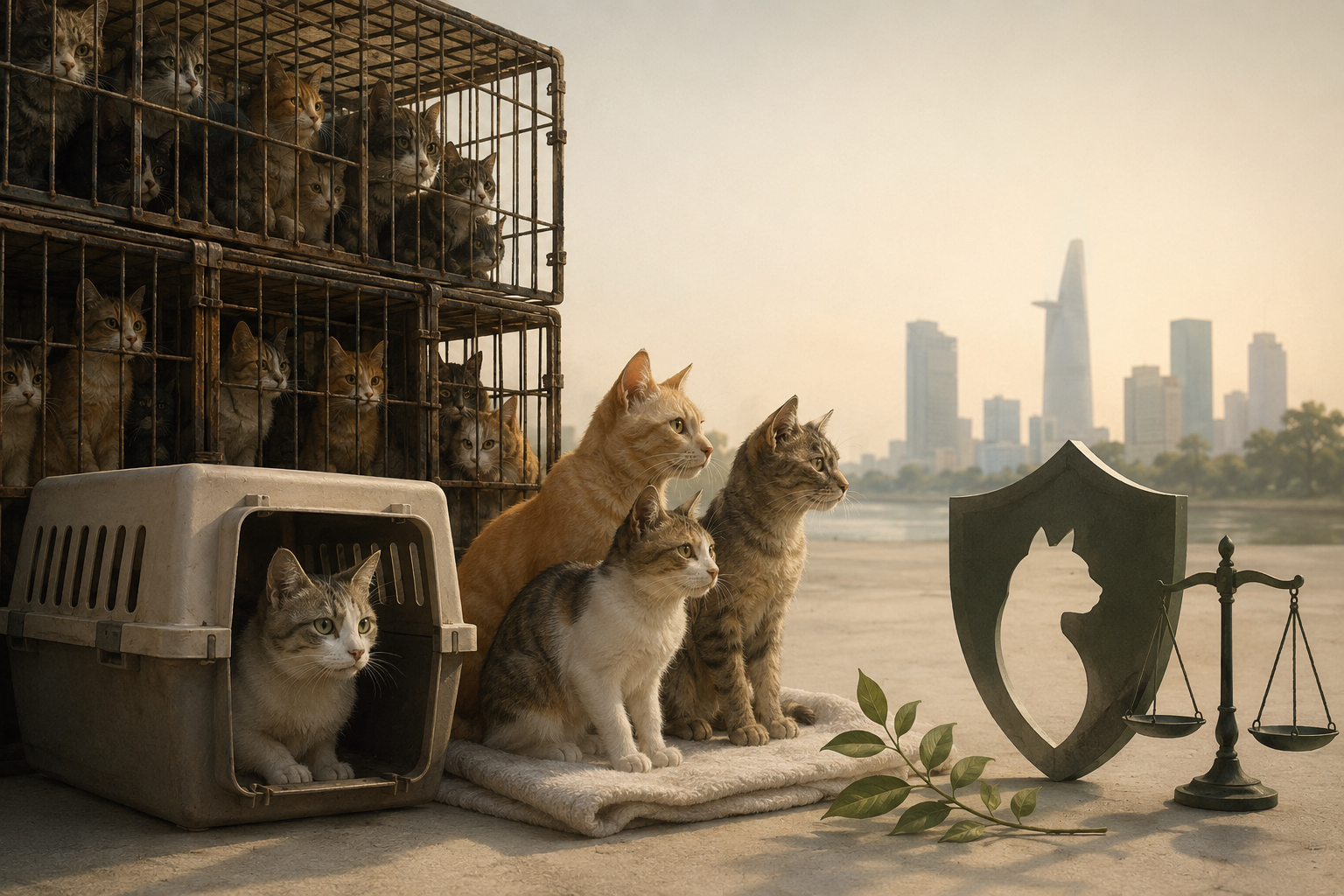
Quick summary: A major police operation in Vietnam has dismantled a prominent pet theft ring by rescuing more than 400 live cats intended for the commercial animal meat trade in Ho Chi Minh City. While the breakthrough has successfully reunited dozens of stolen pets with their families, over one hundred animals tragically died from the severe conditions of their confinement. The unprecedented scale of this criminal bust highlights an urgent need for stricter public policy and enhanced enforcement of regulatory permits to protect domesticated animals, combat legal loopholes, and safeguard community well-being.
Police in Vietnam have rescued more than 400 cats in a significant operation targeting a criminal network involved in the cat meat trade in Ho Chi Minh City.
The multiday action last week resulted in the detention of nine individuals suspected of operating an animal theft ring across southern Vietnam. Officers discovered 45 cages holding around 400 live cats and four ice-filled foam containers with approximately 80 dead cats during a raid on a yard. An additional 21 live cats were recovered at a separate location.
The suspects admitted to trapping and collecting cats across south Vietnam over the past three years, primarily in Ho Chi Minh City as well as the cities of Tay Ninh and An Giang, according to police.
More than 40 of the rescued cats have been reunited with their owners, who had reported them missing amid a recent spate of pet thefts in city. However, around 100 cats died due to the harsh conditions in which they were held, animal welfare groups reported.
Police official Nguyen The Bao told the state-owned Tuoi Tre newspaper: “People who lost their cats can come to the police station to identify their pets and help the police with the investigation.”
Chris Gindelhumer, with the nonprofit Vietnam Cat Welfare, has been assisting with care for the rescued animals at a temporary centre. He said: “Saw quite a lot of tears in the last few days.”
“It’s really beautiful to see how many Vietnamese families are coming, looking for their cats,” he said. “But it’s also heartbreaking because many families were looking for their cats and didn’t find them.”
Many veterinarians and volunteers are working around the clock for the cats, Gindelhumer added. Several of the rescued cats were pregnant, and kittens have been born in police custody.
Karanvir Kukreja leads a campaign against dog and cat meat consumption for the international nonprofit Humane World for Animals. He described the operation as “a sobering reminder of the enormous scale of Vietnam’s cat meat trade.”
Phuong Pham, country director of Humane World in Vietnam, said: “The sad truth about this trade is that thousands of cats every month are being stolen, trafficked, and slaughtered for meat across the country. Thankfully, these survivors escaped.”
Local media described the case as one of Vietnam’s largest cat welfare operations in recent years. A kilogram of cat meat sold for around 70,000 Vietnamese dong (around $2.70), police reported.
Consumption of dog and cat meat remains legal in Vietnam, although vendors require permits to validate the animals’ origins. Certain cities, such as Hoi An in central Vietnam, are collaborating with global animal welfare groups to curb the practice. Following South Korea’s 2024 ban on dog meat, Vietnamese officials indicated plans to strengthen legal protections for pets and their owners.
An Pham, a master’s degree student and avid cat lover in city, said: “This event surprised a lot of people and has raised awareness among many to stop consuming cat meat.”
Animal welfare groups continue to support the remaining cats held as evidence while praising the police action.
About the Author


