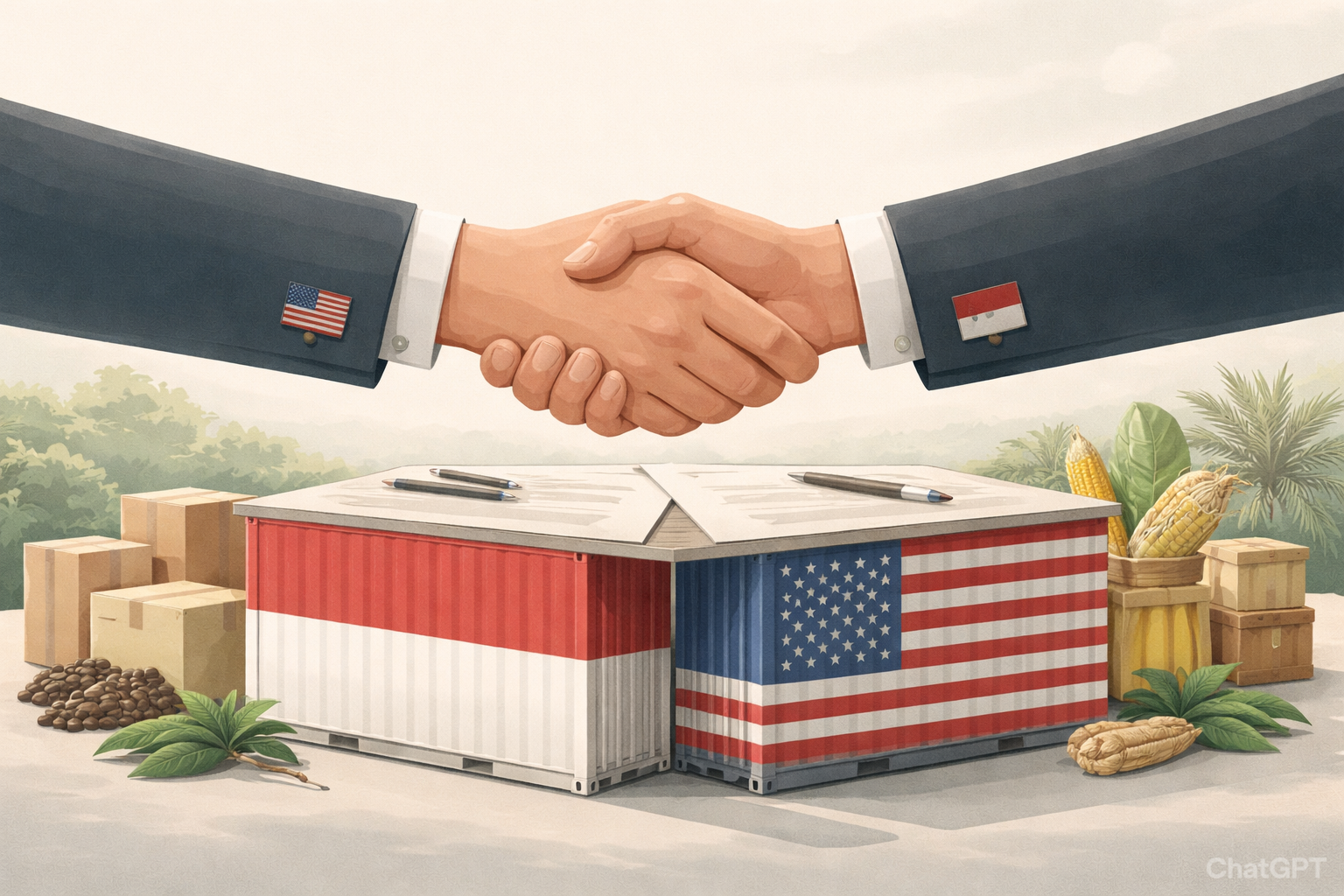
Indonesia and the US have signed a reciprocal trade agreement that sets a 19% US tariff on most Indonesian exports, marking a major step in strengthening bilateral economic ties. The deal follows months of negotiations and builds on last year’s agreement that reduced tariffs from 32%–19%. The agreement was signed by Indonesia’s coordinating minister for economic affairs, Airlangga Hartarto, and US trade representative Jamieson Greer. President Prabowo Subianto attended the signing in Washington, alongside the inaugural meeting of US President Donald Trump’s Board of Peace. The leaders signed a document titled Implementation of the Agreement Toward a NEW GOLDEN AGE for the US-Indonesian Alliance, which the White House described as helping both countries strengthen economic security, promote growth, and contribute to global prosperity.
Airlangga Hartarto called the deal a “win-win” for both nations, saying it “respects the sovereignty of both countries.” Under the agreement, Indonesia will eliminate tariff barriers on over 99% of US products across sectors including agriculture, health products, seafood, information and communications technology, automotive products, and chemicals. Non-tariff barriers will also be addressed. US companies will be exempt from local content requirements, and Indonesia will accept US federal motor vehicle safety and emission standards, as well as FDA standards for medical devices and pharmaceuticals. Burdensome certification, labeling, and pre-shipment requirements will be removed, while long-standing intellectual property issues will be resolved. The agreement also eliminates barriers for digital trade, supporting a permanent moratorium on customs duties on electronic transmissions at the World Trade Organization (WTO), and ensures a level playing field for US electronic payment service companies.
Indonesia has committed to joining the Global Forum on Steel Excess Capacity to address global steel overcapacity. The two countries will cooperate on supply chain resilience, duty evasion prevention, export controls, and investment security. Indonesia will remove restrictions on exports to the US for industrial commodities, including critical minerals, adopt a forced labor import ban, and remove provisions in its labor laws restricting workers’ and unions’ freedom of association and collective bargaining rights.
In return, the US will maintain a 19% reciprocal tariff rate on imports from Indonesia, with certain products exempt at 0%. Indonesian coffee, chocolate, natural rubber, spices, and palm oil will be tariff-free, along with nearly 1,700 other commodities. Textile and apparel products will benefit from a 0% levy under a Tariff-Rate Quota mechanism, potentially benefiting around 4 million workers in Indonesia’s textile sector. Airlangga noted that the deal does not regulate transshipments from China, as such trade does not occur in Indonesia. The US had dropped requests for non-economic provisions, including nuclear reactor development and South China Sea issues. The agreement will take effect 90 days after both sides complete legal procedures, though changes could occur if mutually agreed.
On 18th February, Indonesian and US companies concluded commercial deals worth $38.4 billion. These deals cover agriculture, with purchases of US soybeans (1 million tons), corn (1.6 million tons), cotton (93,000 tons), and up to 5 million tons of wheat by 2030. Energy commodities agreements are valued at $15 billion, while Boeing aircraft and aviation services account for $13.5 billion. Additional agreements cover critical minerals, oil field recovery, computer chips, mining, textiles, technology, and other sectors.
Prabowo told business executives at the US Chamber of Commerce: “We have negotiated very intensively over the last few months, and I think we have reached solid understandings on many issues.” Prabowo described Indonesia as a potential “bridge” and “honest broker” between great powers.
The trade pact was announced alongside the Board of Peace meeting, where Prabowo reaffirmed Indonesia’s pledge to contribute 8,000 troops, or more if necessary, to an international stabilisation force in Gaza as part of Trump’s postwar reconstruction plan. Trump thanked Indonesia, calling it a big country that “does a great job,” to which Prabowo responded: “We are very optimistic with the leadership of President Trump, this vision of real peace will be achieved. There will be problems, but we will prevail.”
Airlangga highlighted that roughly 90% of Indonesia’s tariff-related proposals were accepted and emphasised that the shared vision is for economic prosperity, resilient supply chains, and respect for sovereignty.
About the Author


